Bring your CVs, notes and career history. Explore where your experience can go, shape how you present it, and turn it into CVs, profiles and job leads, with the AI agent you already use.
Most job-search tools start from the feed of postings and ask how many you can get through. The hard parts are elsewhere: knowing what you are aiming at, saying it consistently on LinkedIn, Djinni, Upwork and in a CV, and stopping a language model from quietly turning “contributed to” into “led”. The rules it follows are there because a real generation once got them wrong.
So career-space starts with you. It is a personal career workspace that happens to be public: a folder of facts, rules and small scripts that a coding agent reads and acts on. Your data stays in a gitignored folder next to it.
Start with your story
You do not need a tidy profile first. Hand over what you have: old CVs, a LinkedIn export, cover letters, notes. It reads everything before it asks anything, then asks what a document does not say.
The questions that matter most:
Did you drive this end to end, or contribute to something someone else owned?
What was the state before that number, and were you accountable for the outcome?
What do people keep pulling you into, across your roles?
What would you take, and what would you walk away from?
You
Here is my CV and an old LinkedIn export. I am not sure where I want to go next.
Agent
I have read both. One thing a CV cannot tell me: the payment-provider integrations. Did you design them, or implement a design someone else made?
You
Design and implementation. A colleague reviewed it.
Agent
Then I will write “designed and built”, not “contributed to”. And “close to zero” dropped payments: what was the starting point?
You
A handful of support tickets most months before. Almost none now.
Agent
Noted, with that baseline. Last one: across your jobs, what do people keep pulling you into?
An illustrative conversation, fictional candidate.
Explore where it could take you
It is not only a document generator. Talk to it the way you would to a career consultant: about roles, titles, profiles and strategy. During onboarding it also proposes role profiles at three levels: one well supported today, a credible next-level stretch, and a safer fallback.
Things you can simply ask:
Which other roles should I apply for with my profile?
Is my LinkedIn headline pointing where I want to go?
What would I need to be credible for a Staff role?
Where are we, and what did we miss?
You
Which other roles should I apply for with my profile?
Agent
From your CV and your strategy notes:
Senior Backend or Integrations Engineer: your strongest evidence, the payment integrations.
Platform-leaning backend: a credible stretch, but there is no on-call or SRE work to point at.
Tech Lead: a small stretch. Frame it as technical direction in a scoped area, not running a team.
Not worth chasing: Engineering Manager. You decided against it.
An illustrative conversation, fictional candidate. It answers from your own files, so the answer is only as good as what is in them.
Present yourself anywhere
One professional story, several presentations. LinkedIn, Djinni, Upwork, a portfolio, a targeted CV and a cover letter each get their own audience and limits, and all start from the same facts, so they do not drift apart.
Most of what I do is take a backend ticket from vague to shipped, without needing much hand-holding along the way. About seven years of it, mostly working inside codebases and team processes that already exist rather than starting things from scratch.
Day to day that means implementing features on shared APIs without breaking the clients that depend on them, integrating third-party services, tracking down performance problems, taking part in migrations, reviewing pull requests, and getting delayed work across the line.
A generated LinkedIn profile, fictional candidate.
Upwork
Alex Morgan
Backend Developer — Python / PostgreSQL / API work, available for bounded projects
What I take on: one clearly-defined piece of backend work at a time — an integration, a performance problem, a service to extract, features to add to an API that other things already depend on.
If failed payments or webhook events are silently getting dropped: I’ve integrated third-party payment providers with webhook-based reconciliation and automatic retries, taking a recurring “payment lost, customer complains” problem down to near zero.
A generated Upwork profile, fictional candidate.
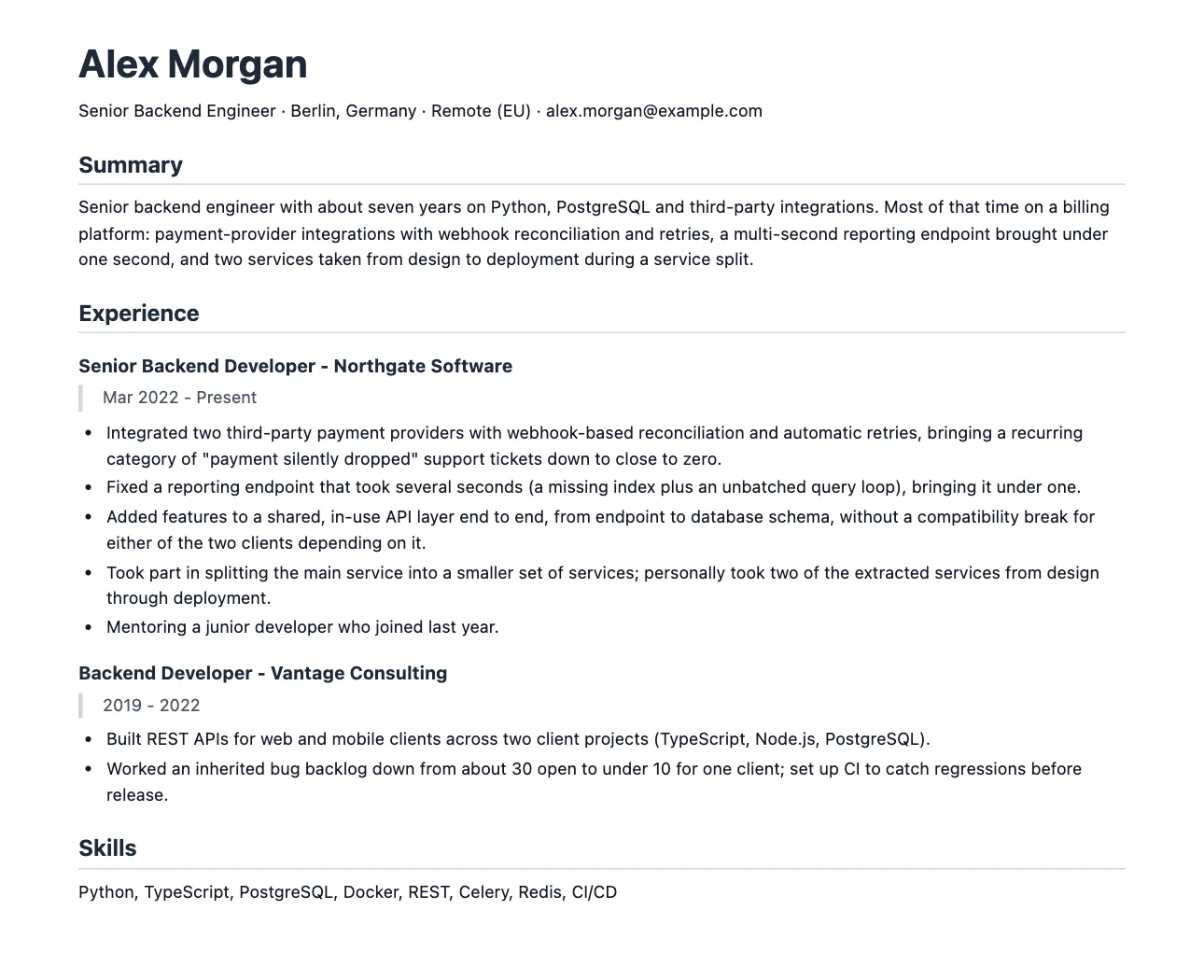
A CV targeted to the Brightloop vacancy above, rendered by the tool (PDF too). Fictional candidate.
Rules against invented facts and inflated ownership guard every draft. They lower the risk, they do not remove it: read what it writes before you send it.
Your context stays yours
A chat helps with one task. Here each task starts from the results of the earlier ones, because they live in files you own, not in a conversation that scrolls away.
Nothing to retell
Your history, decisions and strategy are in your folder. A new session starts from them.
Any compatible agent
Start in Cursor, continue in Claude Code, come back through Codex or Gemini CLI. The next one reads the same files and rules.
No extra platform
No subscription, no account, and no second copy of your professional profile to keep up to date.
Each level sets the frame for the next
1 Strategy · 10 years
2 Positioning · the next year
3 Surfaces
4 Opportunities
5 Feedback
And when you are ready to look for a job
Job search follows from everything above rather than replacing it. The same context decides what is worth your time.
A scout collects vacancies from job boards and company ATS pages, on request, and from LinkedIn job-alert emails if your agent can read your mail.
Each vacancy is compared with what your experience actually shows. Gaps are stated plainly, and the score helps you decide what to apply to first.
Targeted CVs and cover letters for the ones you pick.
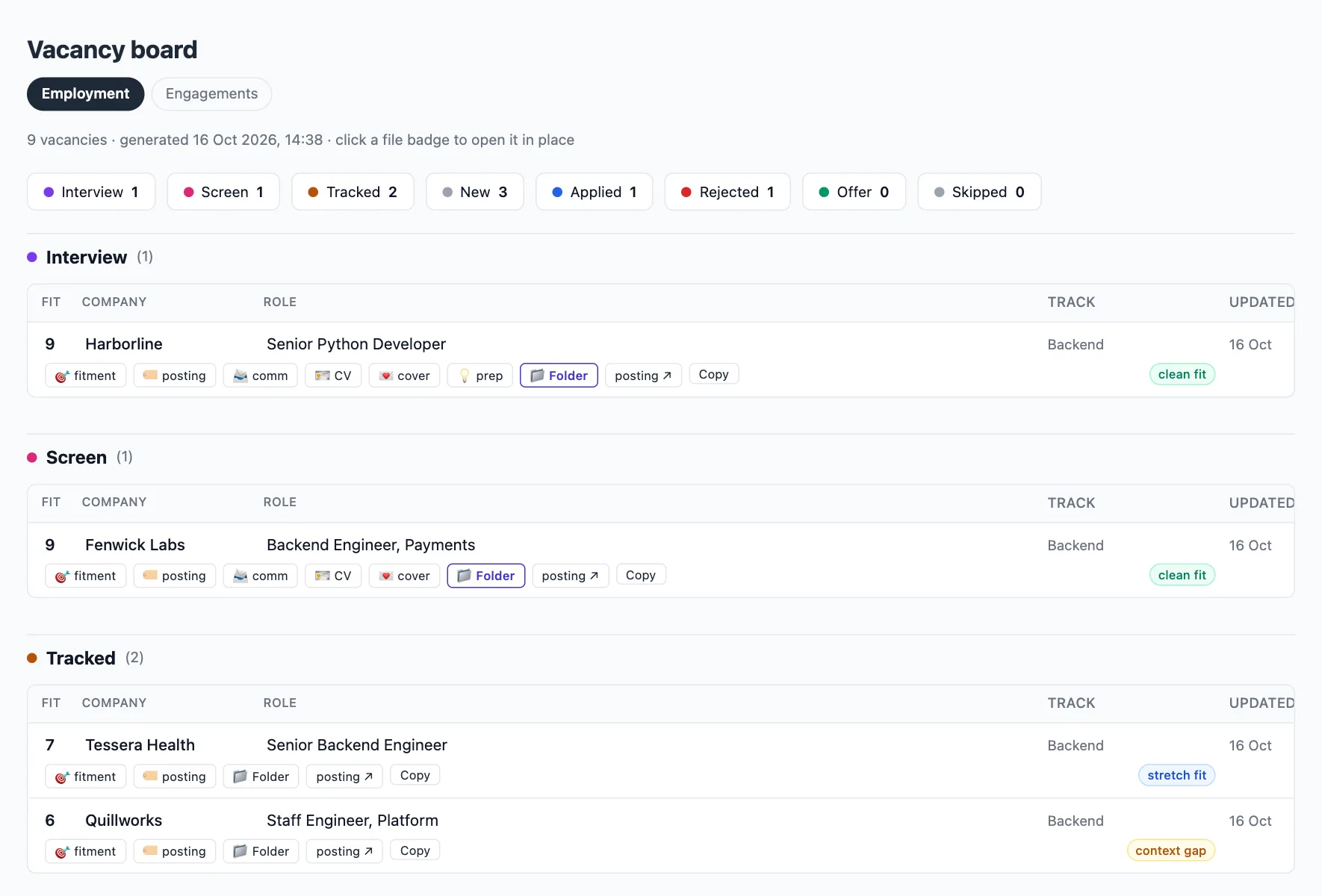
One board for vacancies, client orders, fractional and part-time work. With an email capability connected, it can reconcile statuses against your inbox.
Senior Backend Engineer · Brightloop (fictional)
8/10stretch fit
worth trying, gaps need honest framing
Python and Postgres on a payments-adjacent API, own services end to end, remote in the EU.
Location eligibility: open remote — Remote across the EU; Berlin-based candidate.
Minor gaps
No streaming system anywhere in the CV.
Transferable / partial overlap
Two services, inside a team split that others led.
nice-to-have — One mentee, informal.
Strong overlap
critical requirement — About seven years on a billing platform, including a reporting endpoint fixed from several seconds to under one.
critical requirement — Same shape of work, with a measured effect on dropped payments.
Risk: Kafka is a named requirement with no evidence behind it; expect it to come up early.
Appeal: The integrations and Postgres work match the core of the role almost line for line.
Output of the fitment tool, fictional candidate and posting.
You submit applications yourself. career-space ships no tool that fills forms or sends them; an agent with its own browser tools may be able to help, if you let it.
There is more than this list. The agent can take you further itself, so just ask:
What else can you do?
Where are we, and what did we miss?
Compared with the alternatives
Three things people reach for instead. Scroll through them, or use the arrows.
CV builders and ATS checkers
Starts from
The document
Good at
Polished editors and templates, parse checks, keyword scoring.
career-space
Works with your whole career history, not one document. Drafts are generated under rules against invented facts and inflated ownership; passing an ATS score is not the goal.
AI career tools and plain chats
Starts from
Whatever you paste
Good at
Zero setup. Fine for a one-off question.
career-space
Keeps shared context between sessions and between agents, so each task builds on the last. The same evidence gives the same fit score, because the formula is fixed.
Job-search automation
Auto-apply bots, feed pipelines such as career-ops
Starts from
The feed or the form
Good at
Volume and coverage: very wide source lists, batch evaluation, submitting while you do something else.
career-space
Helps you decide where to go rather than maximizing the number of applications. Starts from your direction and carries it into every application.
Categories, not product reviews: individual tools vary. career-ops was read in September 2026; the rest is described in general terms. The scouting approach was inspired by jobhunt-agent.
Get started
Hand it to your agent
Paste this into Claude Code, Codex CLI, Gemini CLI or Cursor. The agent reads this page and sets everything up by itself, then pulls you into the conversation.
Set up career-space for me: https://career.eggs.gd
It needs an agent that can run shell commands. It:
clones the repository to a folder you choose,
reads AGENTS.md, the rules it will work by,
starts a short onboarding conversation: your CV or LinkedIn export, a few questions a resume does not answer.
Or do it yourself
Clone it, open the folder in your agent and say anything. It explains itself and walks you through setup.
git clone https://github.com/eggs-gd/career-space.git
cd career-space
If you are an agent and your user sent you this page: clone https://github.com/eggs-gd/career-space.git to a location they choose, read AGENTS.md in it and follow it, then start onboarding with them (playbooks/onboard.md). Keep their personal data under the gitignored data/ folder and never commit it.
Then, in plain language
Set me up.
Am I a fit for this role?
Write a cover letter for this.
Check job boards for me.
Show me the board.
Close paraphrases work. There is no syntax to memorize.
Requirements and limits
Needs an agent that can run shell commands, and Node 22.12 or newer for the bundled MCP server, which installs itself on first use.
Your data stays on your machine, in a gitignored folder. No account.
Scouting reads public APIs and the job links in your own alert emails: no login-walled boards. It runs when you ask for it.
It is not a standalone app and not tuned for the largest possible pile of postings.
It is built on language models, which still get things wrong.